
What Is Blood Flow Restriction Training and Who Is It For?
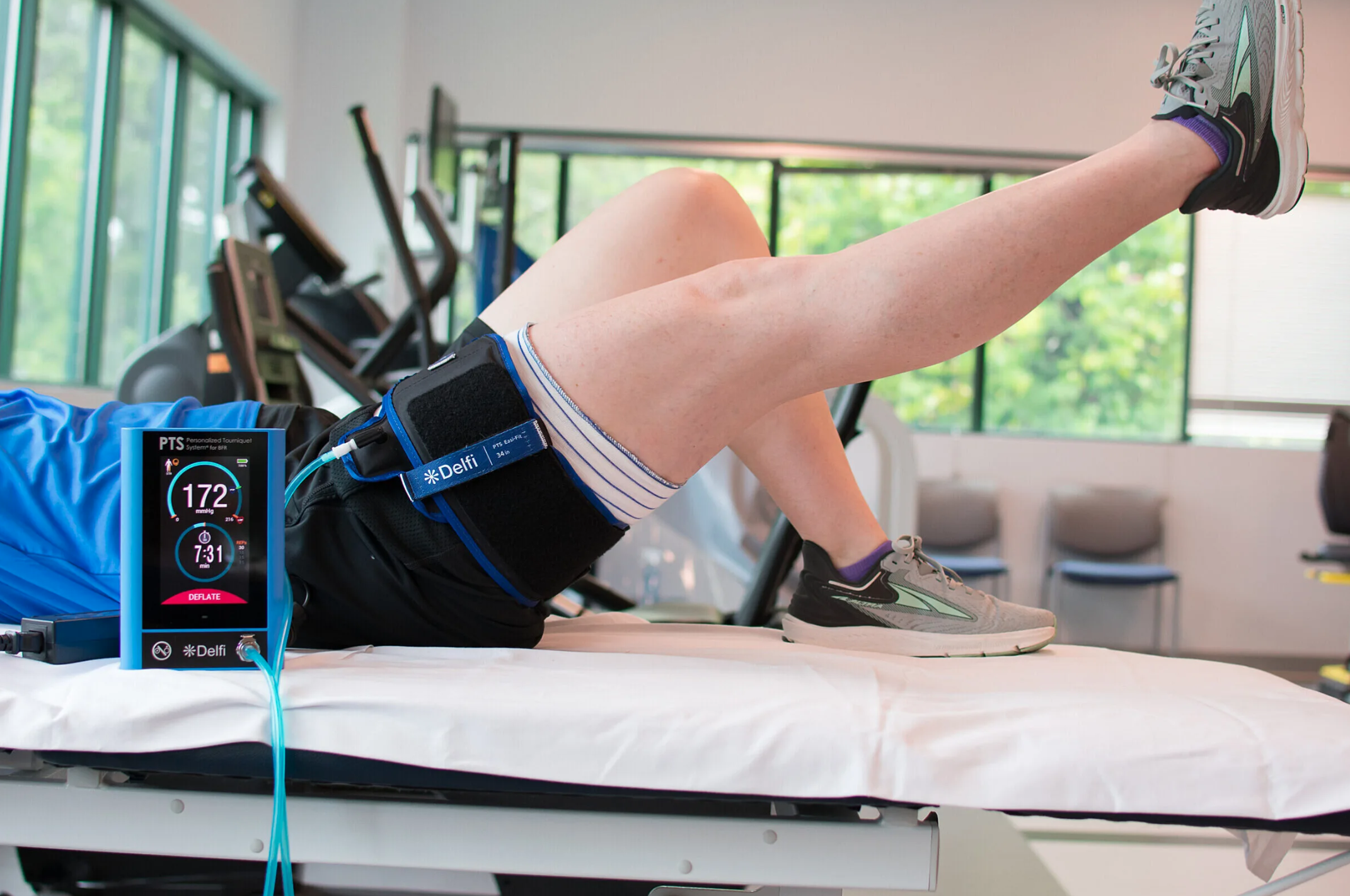
If you have been through physical therapy after a surgery, you may have noticed that one of the hardest parts of early recovery is not pain. It is muscle loss. Within days of an injury or operation, the muscles surrounding the affected joint begin to atrophy. The body down-regulates muscle protein synthesis, reduces neural drive to the area, and the result is weakness that can persist for months if it is not addressed systematically. The problem is that the most effective tool for rebuilding muscle, progressive resistance training at meaningful loads, is often exactly what a healing tissue cannot tolerate in the early weeks after surgery.
Blood flow restriction training, commonly called BFR, was developed specifically to close that gap.
How BFR Works
BFR uses a pneumatic cuff, similar in concept to a blood pressure cuff but calibrated to a specific percentage of arterial occlusion pressure, applied to the upper arm or upper thigh. The cuff partially restricts venous outflow from the working limb while allowing arterial inflow to continue. The result is blood pooling in the muscle during exercise, which creates a significant metabolic stress and hormonal response at loads that would otherwise be too light to produce any meaningful adaptation.
The typical load used in BFR training is 20 to 30 percent of a person's one-rep max. In traditional resistance training, loads that low produce almost no hypertrophy or strength gain. With BFR applied, the metabolic environment inside the muscle changes enough that the body responds similarly to how it would under heavy loading. Research has consistently shown that BFR facilitates gains in muscular strength and hypertrophy at lower loads, allowing for accelerated recovery and reduced disuse atrophy in load-compromised individuals. PubMed Central
Who Benefits Most
BFR is not a technique reserved for elite athletes. Its value is widest in populations where full loading is not safe or practical.
Post-surgical patients are the most common application. After ACL reconstruction, rotator cuff repair, hip arthroscopy, or total joint replacement, the window between "cleared to exercise" and "cleared to load heavily" can be several months long. BFR allows a clinician to drive meaningful muscle adaptation during that window without placing stress on healing tissue.
Older adults are another population where BFR has strong evidence. Research has shown that BFR combined with low-intensity training can improve muscle strength and maintain cardiovascular fitness in older adults, which is particularly relevant given the well-documented relationship between muscle loss, fall risk, and functional decline with aging. Heavy resistance training is often contraindicated or poorly tolerated in this population. BFR provides an alternative that produces similar outcomes at a fraction of the mechanical load. PubMed Central
In-season athletes managing tendinopathy or muscle strain represent a third common application. An athlete who cannot afford to stop training entirely but also cannot load a painful patellar tendon or strained hamstring at full capacity can often use BFR to maintain strength and muscle mass without aggravating the tissue.
Surveys of practitioners in high-performance sports settings have found that BFR is primarily used for injury rehabilitation and for limiting loss of muscle mass, with the majority of practitioners reporting they consider it a safe and effective adjunct to traditional programming. Taylor & Francis Online
What a BFR Session Looks Like at Desert Peak PT
BFR at Desert Peak Physical Therapy is not used in isolation. It is integrated into a broader treatment plan that includes manual therapy, therapeutic exercise, and movement retraining based on your individual assessment. The cuff is applied and calibrated to your limb occlusion pressure, which is measured individually rather than set to a generic number. You will typically perform a series of low-load exercises with short rest intervals between sets. The sensation is uncomfortable in the same way that a hard workout is uncomfortable. It is not painful in the way that an injury or aggravated tissue is painful, and that distinction matters clinically.
Sessions are closely supervised, particularly in early post-operative phases or with patients who have cardiovascular considerations. BFR must be applied appropriately and with caution, particularly in individuals with cardiovascular concerns, which is why clinical oversight is essential and why BFR in a physical therapy setting differs from self-applied BFR products marketed directly to consumers. PubMed Central
Common Questions
Is BFR safe? For most patients, yes. Contraindications include certain cardiovascular conditions, active deep vein thrombosis, and open wounds at the cuff site. Your clinician will screen for these before BFR is incorporated into your plan.
Will it hurt? The metabolic stress produces a burning sensation similar to what you feel during high-rep strength training. Most patients find it tolerable, particularly once they understand what to expect.
How quickly does it work? Most patients begin to notice measurable strength improvements within three to four weeks of consistent BFR sessions. For post-surgical patients, the primary goal in the early weeks is minimizing atrophy rather than building new muscle, and BFR is effective at both.
Do I need to be an athlete to benefit from BFR? No. The technique was developed with clinical populations in mind. Some of the strongest evidence for BFR is in older adults and post-surgical patients, not competitive athletes.
Is BFR Right for You?
If you are recovering from surgery and frustrated by how quickly strength has declined, if you are an athlete managing an injury that will not let you train at full capacity, or if you are an older adult who wants to maintain muscle and function without the joint stress of heavy lifting, BFR may be a useful part of your rehabilitation program.
Desert Peak Physical Therapy offers BFR as part of individualized treatment plans at our clinic on N Zaragoza in East El Paso. To find out whether it is appropriate for your situation, schedule an evaluation with Dr. Marco Suriano at (915) 289-9133 or contact us at desertpeakpt.com.
